

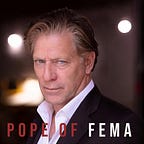

David Webb talks with David Richardson, former acting FEMA administrator and author of Texas Flood 4 July 2025, about the federal programs that keep people building where the water comes back.
Richardson explains why FEMA’s flood maps are actuarial tools, not safety tools, and how the National Flood Insurance Program — in place since 1969 — turned a limited backstop into a nationwide subsidy for coastal and floodplain development. Taxpayers far from the water pay so premiums stay cheap. Developers make billions. When the flood hits, the loss is someone else’s problem. He ties that system to places like North Topsail Beach and to the July 4, 2025 Guadalupe River flood that killed more than 130 people, including children at Camp Mystic.
He also gives his account of the response: coordinating with Texas emergency manager Nim Kidd, Coast Guard rescues, why he stayed in Washington, and his decision to override DHS’s $100,000 contract rule so aid could move. They close on what would actually change the incentives — private insurance, a blended model for people already there versus new construction — and why FEMA, Congress, and the FEMA Review Council keep pointing at each other instead of fixing it.
Transcript
David Webb:
But let’s get a little bit more into the weeds. FEMA’s outdated flood maps and FEMA’s billion-dollar gravy train. David Richardson, former acting FEMA director, joining me now. And David, as we hear, the late storm of late storms about to come on shore in the Gulf seems an appropriate title and topic. But thanks for joining me this morning.
David Richardson:
David, thanks for having me. I love your show, by the way. You’re doing great things for the American people.
David Webb:
I appreciate that. With guys like you to help me and what you’ve sent me, that’s how we help people. And I really mean that. Let’s dive in because your recent op-ed on FEMA’s billion-dollar gravy train exposes so much right down to the outdated flood map. So help us understand this more.
David Richardson:
Yes, so I’ll talk about the flood maps first because the flood maps are tied to something called the National Flood Insurance Program. And the National Flood Insurance Program is designed to essentially rebuild structures in the floodplain after they get flattened or really from flood damage by hurricanes or any other type of flood. And essentially, it’s a subsidized program. And by subsidized, I mean everybody across the country is paying so that people living in the coastline and in floodplains can have cheap insurance. It’s changed a little bit over the years. But in general, it’s the same program we’ve had since I think it’s 1969. And it was never intended to do that. So it was never intended for communities to pop up in places like North Topsail Beach, North Carolina. Where I lived for a while, which is essentially a sandbar. And every time there’s a hurricane, the structures get knocked down and the National Flood Insurance Program assists in rebuilding them. All of these coastal communities, for the most part, have popped up since the National Flood Insurance Program. And here’s the deal on the flood maps. The flood maps support the National Flood Insurance Program. And the way they do that is there are lines drawn in these Floodplains, and they dictate how high the premiums are. And FEMA will tell you that the flood maps are for actuary purposes only, and they are not predictive. They have nothing to do with safety and precaution. So that’s kind of how the flood maps work. They’re not ideal. There’s better ways to do it. But FEMA chooses to stick with the old way of doing it, and that’s partially—I know you’re familiar with the Camp Mystic and the children that died there and the children that died along the Guadalupe River. Between the National Flood Insurance Program and the flood maps, we’re allowed to build in the floodplain because of that. But the key point is they have nothing to do with safety or precaution. It’s all actuary information for insurance. So that’s kind of the story on the flood maps.
David Webb:
Yeah, so the name doesn’t really fit the reality, I guess. And by the way, David’s book is Texas Flood, Power, Money, Politics, History, Bureaucracy, and Tragedy. Picture the Texas flag on there. I’m reminded, David, and it was a tragedy in a sense. I remember when the Trinity flooded in the 90s in Houston. There was a house floating down the river on fire because it was on the banks of the Trinity. You know, just one of those areas that you didn’t think till you saw the news roll of it. But these areas that are being built up, infills and, you know, all of this. I mean, people are making, I don’t know, I call it bad decisions. Am I wrong?
David Richardson:
No, you’re not. Number one, people are making billions of dollars by building in the floodplains and selling condominiums and what have you. It’s not a prudent decision, and it wouldn’t be allowable—not allowable, it wouldn’t be feasible unless you had the National Flood Insurance Program that started in 1969. And by the way, one of the architects of the program, there were some senators at the time that said this is going to backfire. Instead of simply insuring the structures that were currently in the floodplain, it’s going to cause a building boom in the floodplain because when the floods do come, the damage is going to be, ding, ding, somebody else’s problem. And that’s exactly what happened.
David Webb:
Oh, God. You know, the minute you say Senate, I just—something I read—the hairs on the back of my head raise up. My guest, David Richardson, former acting FEMA administrator. Let’s dive into more of the topic areas that we want to hit on here. And again, the book Texas Flood, it’s available wherever books are sold. It’s an inside account of disaster response, the bureaucracy, the leadership decisions made. As you put it, under extraordinary pressure. And it is pressure. When these events, these tragic events fold out, communities are uprooted in so many ways. Not just people, not just property, even animals. Agriculture, wild animals, so much is in this mix. And yes, we often think of that scene, the reporter, the storm, the wind blowing. We see that. But what’s really going on here is the destruction of so many lives in so many ways. Let’s go into that a little bit more. What happens? And, you know, Texas, Texas flood. Use Texas as that example.
David Richardson:
Yeah. So in Texas Flood for July 2025, I describe that. The conditions that caused that flash flood. And there have been five or six of those in American history. And what happened there was a storm settled over the hills of Texas. And it got stuck there for reasons that we don’t need to get into, but it’s not climate change. The primary cause was the storm that stalled over the hills of Texas. And then what happened was there was potentially some failed warning systems. And there was also some talk about the weather predictions never being perfect. Well, I’m not telling anybody anything new, but warning systems are never perfect. And the weather forecast is never perfect. And in that case, there’s a bill right now on the president’s desk. I think it’s HR 7022. Called the Camp Mystic Alert Bill. It addresses one of the proximate causes, but it does not get into the deep cause, as we just discussed, of actually building in the floodplain, which is allowed by two FEMA programs, the National Flood Insurance Program, as well as the flood mapping. So what happened there was I got a call about 12 in the afternoon on 4 July while I was driving to Gettysburg, Pennsylvania with my two boys. And it essentially outlined that what had happened about somewhere between 1 and 4 in the morning, that flood had—correction, thunderstorm stalled out and was causing mass flooding. I think it was like three months’ worth of rain fell within like 72 hours. So it was massive flooding. And they were in the floodplain. And partially the reason they were there, as I’ve said three times now, were because of FEMA programs. So immediately, the emergency manager for Texas and myself, Nim Kidd, began to coordinate search and rescue teams to get to Texas. Unfortunately, and this is kind of tough to talk about, most of that would be search teams. The Coast Guard was already on the ground. That was Sean Planky and his crew. There were already FEMA teams or FEMA-trained teams from Texas, and Nim was coordinating the search and rescue, and he had a very tight schedule that he was coordinating with. You don’t want too many people on the ground in one place because otherwise it turns into a pylon sport. So with my small team, and I excluded a lot of people from that team, and they were angry and they went to the press and said I couldn’t be reached. That was false. That’s simply because I excluded them because they didn’t have the emergency management experience in a crisis to handle it like me and them and a few other folks did. So Nim and I coordinated the search and rescue. And the search and rescue that came from out of the state, Nim didn’t need that until Monday. And that’s when they arrived. And once again, unfortunately, that was mostly a search effort. There was a lot of rescuing going on. I think the Coast Guard got somewhere around 250 people from whether on the ground or out of trees. So it was a very successful operation in a very unfortunate situation. And as President Trump said, that’s exactly how FEMA should work. One thing I never did was I didn’t encroach on Nim Kidd’s turf. He’s the emergency manager for Texas. He’s the person closest to the problem, and he was best equipped to handle it. The major problem we had during the 4th July, Texas Flood 2025, it had to do with something called the 100K memo that DHS had put in place. Probably not everybody knows about it, but essentially the secretary said that she was going to sign off on any contract over $100,000. Well, in a disaster, you get into the millions very, very quickly. So at some point, because I had done my homework on what happens during a disaster, I coordinated with my team and I realized that I was probably going to have to override that hundred thousand dollar memo because it put a whole other layer of bureaucracy in place. So I think it was on Sunday, the 6th of July, I made the decision to override it so that the people of Texas could get what they needed from out of state on that Monday. It was a tragic event. I mean, over 130 people got killed. I flew over the next week. Once again, I stayed in Washington, D.C., because that’s where the greatest point of friction for me was. That’s where I was needed, so I could override the memo if needed. The next week, I went to Texas, and I flew, and it was—I’ve been in a war zone. Some people say it looked like a war zone, which always makes me scratch my head, because most people haven’t been in a war zone.
David Webb:
You’re a former Marine. You certainly understand that.
David Richardson:
Yes, and I understand crisis management, emergency management, what to do in a bad situation, how certain people have to be cut out because they don’t provide any necessary input. And so that was a small, tight operation that we did to make sure they got what they needed. I never encroached on Nim’s territory. I stayed in Washington, D.C. because that is where the greatest point of friction was. And weeks before that, because we had war-gamed similar situations, I knew that the $100,000 memo was likely going to get in our way because the level of bureaucracy it put over us. So I stayed in D.C. and made sure that the people of Texas got what they needed on time, on target.
David Webb:
My guest, David Richardson. The book, again, is Texas Flood, the date for July 2025, part of that title. There are many questions, David, many, many questions I have about this, but also another aspect of this, and I think in terms of solutions and forward-looking steps, broader question, what are some of the actions that should be taken to deal with the very real-world effects of this insurance program? In that vein, would something or some change that brings the private insurer back into the picture more, which would bring more of a market and realistic assessment, the insurer would assess risk before authorizing, would that help?
David Richardson:
It’s interesting because part of solving this problem is asking the right questions. And David, you’re asking some of the right questions. And by the way, I’ve been writing articles with a few other folks, and you can see the articles at the popeoffema.com or popeoffema.com at Substack where we outline a lot of this. So to directly answer your question, whether or not private insurance can handle this is up for debate. So the president appointed the FEMA Review Council, and one of the recommendations they made was that private insurance take over where the National Flood Insurance Program is working now. There’s a challenge there, and this is the challenge, and this is something that your viewers are kind of aware of, but they don’t really understand the impact. To build in most of the floodplains where structures are now, or for private insurance to take over, the premiums would be so high that likely the people living there now could no longer live there.
David Webb:
Can you just hit pause there for a second? Let me add a little more to this because kind of expected that because that’s the very real assessment of it. In that case, and from a property and casualty approach for the private insurer, and I know we’re getting a little weedy here, folks, but you need to understand this because some of you live there. What about a blended model, a protection for the people that are there? There has to be some cutoff point to a degree, but then new build and new development coming in. If you have to meet the private insurer, the property and casualty insurance stack to get that done, would that help limit the build where, frankly, it shouldn’t be built?
David Richardson:
David, the answer is yes. And if you and me and 10 of your listeners all sat down on the table, we could figure this out. If we asked the question why enough, if we really decided what the problem the insurance is solving, we could come up with a blended solution that would address the issues and would also find a better solution for the flood maps. The challenge is FEMA has been trying to do this for years, and they can’t get out of their own way to do it. FEMA points at Congress. Congress points at FEMA. Now there’s a third party to point at, which was the presidential council on reforming FEMA. And I can tell you, none of the reforms will happen because FEMA—the schedule was two to three years and National Flood Insurance Program was something on the agenda, but they asked for a two or three year period for it to be addressed. And as you well know, David, a two to three year period is might as well be a century in Washington, DC, because things are going to change. Different people are going to come into place with their own interests, and the recommendations of the FEMA Council will never be realized because FEMA can’t figure it out.
David Webb:
If they ever get their act together, I literally will do this. I will send them four books written by my father, Property and Casualty, used to teach insurance, still used today, four textbooks. The guide map for the private market, the risk assessment, frankly, and the answer that a lot of people don’t want, you shouldn’t do this. Is what the private market will say sometimes. This blended model can lead us down a path. The discussion doesn’t have to be one or the other. You have to take care of the people that are there to the degree that they’re stuck or whatever. Costs are there. But also, sometimes you have to reduce the use of what is a bad decision or a bad area. I don’t know. I’m just a realistic guy.
David Richardson:
A little bit of history. There was a great flood of 1927 on the Mississippi River, and essentially 700,000 people were displaced. My father was one of them. Many of them joined the Great Migration and went north. There used to be private flood insurance, but the great flood of 1927 on the Mississippi River ended it. So they all went bankrupt. So for about 40 years, we tried to engineer ourselves out of the problem. And then once things like waterborne diseases like cholera, malaria, and others were cured, suddenly the coastlines and the river lines were available for development. And that’s how you and me and the rest of us that are not so well-heeled are paying for the property losses of the well-heeled living on the coastline. So it’s a little bit more insidious than appears on the surface. And I guarantee your father—because what he knew about insurance could have predicted exactly what has happened. All of us are paying for the coastal living style because of the National Flood Insurance Program and flood maps. The worst thing about flood maps, however, and you alluded to this, is that they have nothing to do with safety and precaution. And most of us reasonably would think that they do, but they don’t.
David Webb:
It’s the misnomer. That’s what it is. Texas Flood, 4 July 2025. Great read. Power, money, politics, history, bureaucracy, and tragedy. And out of this, what David and I are talking about, there needs to be a… David, that’s to you and all of your listeners. Thank you. And keep going. Texas Flood for July 2025.
David Richardson:
All right.
David Webb:
You got it, my friend. Available wherever books are sold. All right. 866-95-PATRIOT, 957-2874. I’ll be right back.


