

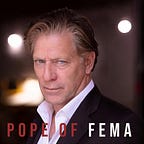

The National Security Hour · America Out Loud Talk Radio
Hosts: Dr. Michael Scheuer and “Colonel Mike” · Guest: Lt. Col. David Richardson
Editor’s note. This is a cleaned-up transcript prepared from the show’s auto-generated captions. Mis-heard names and terms have been corrected (e.g., Kristi Noem, Tom Homan, Camp Leatherneck, Countering Weapons of Mass Destruction, DOGE, Guadalupe River), repeated words and verbal stutters have been smoothed for readability, and station promotions and advertisement reads have been removed and marked. The substance and wording of the interview itself are preserved. Because both hosts speak throughout, a few host attributions are best-effort and may need correction.
SEGMENT 1
COL. MIKE: Welcome back to another episode of The National Security Hour on America Out Loud Talk Radio. Today we have a really big show — like Ed Sullivan used to say — and I’ll tell you why. We have with us Dave Richardson. He’s got a new book coming out. What was he doing? He was working with the government. So what could possibly go wrong working with the government, right? Dave, welcome to The National Security Hour. We want to discuss this new book, and we want to tell people how screwed up FEMA is.
RICHARDSON: Thanks for having me. I greatly appreciate it. I’m really glad to be here to speak with you two gentlemen.
COL. MIKE: So, Dave, why were you chosen to lead FEMA? What qualified you?
RICHARDSON: Number one, I’ve got a background in strategy. I was a ground combat officer in the Marine Corps in a couple of different theaters of war. I went to the Marine Corps schools and essentially learned how to plan, build strategies, and do things like mission analysis. After I got out of the Marine Corps — partially due to what I did in Korea — I got into the countering weapons of mass destruction business. Eventually I was appointed by President Trump in 2020 to be the Assistant Secretary for Countering Weapons of Mass Destruction. When Trump didn’t get back into office, I spent four years doing similar work. When he came back into office, I returned as the Assistant Secretary at the Department of Homeland Security for Countering Weapons of Mass Destruction — and I was immediately told they were going to shut it down. Look, I’m a small-government guy, partially because, as you said, the government can be a mess. The smaller the government, the smaller the mess. So I turned to shutting down Countering Weapons of Mass Destruction. I’d done a mission analysis on it. It’s simple: you go to all the laws, figure out what you should do by law, do only that, and match the people to the law and the capabilities. As I was shutting that down, the President had expressed a desire to do the same at FEMA — like had been done at the Department of Education, and then USAID. Since I was having success systematically shutting down Countering Weapons of Mass Destruction — and that wasn’t happening to the President’s approval at FEMA, which he wanted shut down or drastically reduced and rebranded — they removed the person running FEMA and sent me over. I made no bones about it when I got there. There was much howling and gnashing of teeth the day I told them I intended to carry out the President’s intent, because they knew what that was: shut it down, or drastically reform and rebrand it. I lay all this out in my book, Texas Flood 2025.
COL. MIKE: So hang on — what did you find when you got to FEMA?
RICHARDSON: As I say in my book, I found people wandering around the seven floors at 500 C Street SE, essentially saying their morale was low and that they couldn’t do their mission. I immediately turned to addressing both. A note on federal employee morale: it’s a perennial problem. It’s always low, because they have a sneaking suspicion their work doesn’t matter — and in some cases they’re right, because they’re stuck leaderless, with no one pointing out the mission and driving them toward it. So they wander around and complain. And even if one person is cut, they’ll go to the press and say, “We can’t do our mission — of 18,000 of us, there are only 17,999 left.”
COL. MIKE: This almost sounds like Voice of America when they started cutting VOA — “You don’t understand, we need to check the birds in Ghana, the ones with that special whistle, we just can’t report anymore.” So you had a plan to shut it down. Mike and I both lived in Northern Virginia; you’re in Northern Virginia. We understand the morale — every year when the government’s going to shut down, the world ends. It’s War of the Worlds. So what was your plan?
RICHARDSON: My plan was very similar to the one I did at Countering Weapons of Mass Destruction, and it’s simple. The military calls it “troop to task.” What do you have to do — your mission — and what are the subtasks? You figure out your specified tasks and subtasks and align the people to them. That tells you what your org chart should look like. Most government people, when told to reorganize or reduce, immediately go to the org chart. That’s 100% the wrong answer. You go to the law, figure out exactly what it tells you to do, figure out how many people you need to do it, and then build your org chart. Otherwise you’re just stirring the pot — which is what I think my predecessor did, because I don’t think he had a strategic-level understanding or knew how to do mission analysis. When I walked through the door, I’d already had my team at Countering Weapons of Mass Destruction do a mission analysis on FEMA, and we redrew the org chart. There were 6,000 people at FEMA headquarters. I quickly discerned we only needed about 2,000 of them. There are another 12,000-plus FEMA people in what they call “the field” — which always makes me scratch my head, because as a ground combat Marine, “the field” means living in the woods. Instead, many of these field offices are living in hotels on per diem, overseeing a bureaucratic process for handing out FEMA money that goes on for years. So there were two pots. At headquarters, they needed maybe 2,000 people to do what 6,000 were doing. It took me the summer to figure out what to do with the roughly 17,000 to 18,000 in the field. I started from what the law requires, matched people to it, and my plan was to cut FEMA — headquarters down to 2,000, and eventually the field down to about 4,000. Keep in mind, during Hurricane Katrina FEMA was about 4,000 people. It’s grown to the behemoth it is today — around 18,000. Right about the time I got there, the FEMA Review Council stood up. I collaborated with them as much as I could, because they were moving the same direction, but it was a committee — and I don’t lead by committee. I knew it would be slow. My plan was to have it down by about half by the end of October 2025, and to cut more over the next six or seven months. If I’d stayed, it would be no more than 8,000 people, not 20.
COL. MIKE: Let me ask you — what was your budget at FEMA?
RICHARDSON: Get ready for this one. About $30 billion. And keep in mind: a million seconds is 12 days; a billion seconds is 31 years. I’d managed a budget at Countering Weapons of Mass Destruction of about $400 million. Now I’m dealing with a pot of gold. The money at FEMA is DHS’s largest calf to be slaughtered. Thirty billion dollars. That’s a drop in the bucket compared to the Department of Defense, but for DHS it’s the pot of gold for anybody who can hand it out and get the credit.
COL. MIKE: So what’s the DHS budget itself?
RICHARDSON: I don’t know the total — I’d be guessing. Anybody could do a quick search. I imagine it’s probably double FEMA’s, so maybe $60 billion, but I don’t know.
COL. MIKE: Michael, let me ask you — back when you were at the Agency, what was the budget?
DR. SCHEUER: I have no idea.
COL. MIKE: You don’t remember?
DR. SCHEUER: I don’t know if I even asked. I wanted to know how much money I had to run my operations.
COL. MIKE: How much did you have?
DR. SCHEUER: The most I ever had was about a million and a quarter. If it was a terrorism problem, you’d get all the money you needed. But most years I came to the end of the year and they had money to give away — instead of returning it to Congress, they’d give it to the Pakistanis or the Thais or some other friend around the world. So it’s waste incorporated, in some ways.
COL. MIKE: By the way, I just looked it up. FEMA’s budget is about double, as I said — DHS is somewhere between $60 and $65 billion. So FEMA was about half the DHS budget.
DR. SCHEUER: Wow. That’s a lot of money.
COL. MIKE: We’ve got to take a break. We’re on with Dave Richardson, talking about FEMA — another one of these boondoggles. We’ll be back in two minutes.
— Advertisement break omitted —
SEGMENT 2
COL. MIKE: This is how bad the government is. You want to know how we got to $40 trillion — besides sending money overseas, paying off everybody around the globe, throwing money in the street? You have an agency like FEMA, an agency like DHS. Remember, DHS came into being right after 9/11 — and last week was the 25th anniversary of 9/11. So, Dr. Michael Scheuer, Osama bin Laden hunter — where are we 25 years later in the world of terrorism? Anyway — Dave, how did Secretary Kristi Noem’s “$100K memo” impact your mission? What was that all about?
RICHARDSON: First, let me say — I remember when Osama bin Laden was killed. I was sitting on my rack in Afghanistan on Camp Leatherneck, listening to the BBC on a radio I’d carried out of Iraq. I’ll never forget it. Anyhow — the $100K memo. What Secretary Noem did was try to solve the problem of the American taxpayer’s dollar being squandered. A noble problem. But I don’t think her solution was ideal: she said she would personally sign all contracts over $100,000. Normally that’s something you delegate — something reasonable would be around $20 million. Remember the magnitude: a million seconds is 12 days, a billion is 31 years. Nobody — even with an autopen — could sign every contract on a $30 billion budget. Oversight of contracts is key, but you’ve got to make sure the contracts still get out the door. If you owe people money, it’s got to go out. Put that kind of bureaucracy on top of the system and you can’t pay people in time. To her credit, she was trying to solve a real problem — but she only came up with one solution when there were others. When I got to FEMA, I immediately asked about hurricane season, because I was sent there three weeks before it started on June 1. I cracked a joke once — “Huh, who knew it was hurricane season?” Everybody knew it was a joke, but somebody ran to CNN and said I didn’t even know.
COL. MIKE: Oh my gosh — these wimps you worked with. What wimps.
RICHARDSON: It didn’t bother me. The truth eventually comes out; I know how history works. When I got there, I knew my mission was to shut down or radically transform FEMA — but I also knew it was hurricane season. So I had the operations officer walk me through a series of war games where I saw exactly what happens during a disaster historically — three or four days before a hurricane makes landfall, and ten days after — with a graph of the money spent. In a Category 3 hurricane, which we used as a model, I recognized quickly that the $100,000 memo wasn’t going to fly, because by day two of a disaster we were spending $500 million. I wasn’t going to be able to sign all the contracts — we’d have to delegate. Leaders reduce ambiguity and then go to the greatest point of friction. So I did war games for hurricane season with all the states that would be majorly impacted. When the floods came in Texas, I already knew the $100,000 memo would be a problem, because we’d start having to write checks for four and five million dollars to get search-and-rescue in place. On July 4, when the tragedy happened at night, I was on my way to Gettysburg the next morning. I got a call telling me to phone the congressman in Kerr County, Texas. Then I immediately called Nim Kidd, the emergency manager in Texas, and asked what he needed. He said “nothing right now,” because Texas already had search-and-rescue with the Coast Guard and FEMA-trained teams, plus the National Guard. But he said that by Monday he’d need the release of search-and-rescue folks from Colorado and Missouri. That’s when I began sounding the alarm that we’d need a waiver on the $100,000 memo, because that runs into the millions.
COL. MIKE: Dave, one second — let me bring the listener up to speed. This flood in Texas — did it have a name? What time of year was it?
RICHARDSON: It was July. Anywhere you have hills, a river, and people living in the floodplain, it’s prone to flash floods. It hadn’t rained all spring in Texas, and they estimate a couple of months’ worth of rain fell over three or four days in the Hill Country. The Guadalupe River originates in the Hill Country, so all that water ran off into tributaries, piled up, and caused a major flash flood. When I flew over a week later, I saw huge cypress trees dragged down, many houses stripped to the concrete slab, semi-trucks — the water just carried it all away. What I did was override Noem’s $100K memo. I signed the relief Texas needed and sent it downrange. I gave the process its chance, but the bureaucracy got in the way, so I did it myself.
COL. MIKE: How hard were you hit? How hard did the congresspeople or committees come after you?
RICHARDSON: It wasn’t hard at all, because they were going after the wrong things. They asked me where I was on July 4. I was on my way to Gettysburg when I found out, and I continued, because my greatest point of friction was in DC, where I had to kick down the doors of bureaucracy — the bureaucracy DHS put in place to handle the $100K memo. They also asked why I didn’t go to Texas. First, I didn’t want to be seen on stage with Secretary Noem. She wanted to run down to Texas; my job was here, making sure they got the relief they needed. I talked to Nim Kidd that Saturday and asked where he needed me. He said, “I need you there to make sure the emergency declaration gets to the President on time, and that we get the search-and-rescue we need.” Those were the pieces of bureaucracy I had to outmaneuver. Had I gone to Texas that weekend, it wouldn’t have made any difference — I’d only have gotten in the way of people doing their jobs.
DR. SCHEUER: The thing about bureaucracy in DC is that if you’re a successful officer doing the right thing, you can sometimes tell people to go stick it and just get on with it, because they see you’ve been in a place where you were successful. Otherwise it’s a nightmare — the ability to stop important things for idiot reasons. In the intelligence world, you get quizzed by lawyers about what mask you’d put on Osama bin Laden if you captured him, so you don’t pull his beard. There’s enough stupidity in the system to sink more than one country.
RICHARDSON: The bureaucracy gets in the way so much because everybody’s trying to preserve their five years. As I say in my book, a leader’s job is to reduce ambiguity — through training and exercises, being clear about intent and mission — and then, when things hit the fan, you go to the greatest point of friction, whether it costs you your life, your job, or your reputation. When the flood happened, there was no doubt in my mind I needed to be in Washington, so I could kick down any doors of bureaucracy and get Texas its emergency declaration and search-and-rescue. I’m glad I did — I wouldn’t have understood the immediacy of having to override Secretary Noem had I been on the plane with her.
COL. MIKE: You said $500 million — that’s a big number.
RICHARDSON: In that case it wasn’t $500 million, but it was in the millions — far more than $100,000.
COL. MIKE: Before the break — let’s talk about the relationship between FEMA flood maps and national flood insurance. Our neighbor, southern West Virginia, floods every year. What’s the relationship?
RICHARDSON: Number one: flood maps have nothing to do with safety or precaution. The most senior people at FEMA who handle flood maps will tell you they’re not predictive — they’re for actuarial purposes, to inform the National Flood Insurance Program, which started in the late 1960s. There was no flood insurance, public or private, between the late 1920s and the 1960s — because of the Great Flood of 1927 on the Mississippi, which bankrupted private flood insurance. From the late 1920s to the late 1960s, we tried to engineer our way out of the problem. Then the government created the National Flood Insurance Program, which spread the cost of premiums across the country. It was intended to insure structures already in the floodplain, but it backfired: because the burden was spread nationwide, construction companies and others began building in the floodplains — because if wind or water ruined something, it was somebody else’s problem, and the premiums were artificially low. That’s why you have coastal communities all down the coast, popping up on sandbars — when the structures blow down, the premiums stay low because somebody else is paying for them.
COL. MIKE: We’re going to the break. Go visit our sponsors — this is the only place you get freedom of speech. We’ll be back in two minutes.
— Advertisement break omitted —
SEGMENT 3
COL. MIKE: Welcome back to the final segment of The National Security Hour. Let me ask you — you knew Kristi Noem, you met her; she was head of DHS at the time. In your honest opinion, was she really competent to run this thing?
RICHARDSON: I told Congress she did a good job during the Texas flood, and here’s why: she essentially got out of my way. In that sense she led well — but only because she got out of my way. I was glad she flew to Texas so I didn’t have to deal with her here. In my book I call her “the main act,” because it seemed to be the Kristi Noem show, and I don’t think that’s the appropriate thing for a leader to do. The $100K memo was very short-sighted. So I kept her at arm’s length. I didn’t go to the parties at her house, because it just wasn’t the type of leadership I’d grown up with in the Marine Corps.
COL. MIKE: This isn’t coming from you, Dave — I just have to throw in a little satire: it was “The Kristi Noem Show,” starring Corey Lewandowski. Okay, continue.
RICHARDSON: I had to tell a buddy one day, “Whatever rumors are out there, they’re probably just rumors — I’ve got bigger fish to fry.” I never really paid attention. I was focused on shutting down Countering Weapons of Mass Destruction, radically transforming FEMA, and dealing with the disasters. Back to the connection between flood mapping and flood insurance: the flood maps aren’t about safety or precaution — they’re there to inform insurance, and the premiums are set artificially low because we’re all paying for them. That’s encouraged building in the floodplains. If my uncle — whose house was ruined when the Black River in Arkansas overflowed because he lived on the wrong side of the levee — had ever seen Camp Mystic or the places along the Guadalupe that got destroyed, he’d have said, “David, it might not be today, it might not be tomorrow, but I know a lot about rivers, and someday there’s going to be a flash flood here, and a lot of people are going to suffer.” Instead, we’ve built these communities on the artificial back of national flood insurance, because it’s a federal program and it makes us feel like we have top cover. It’s not top cover at all — it’s cheap insurance made artificially low because someone in Iowa, Washington State, or Arkansas is paying for it. That’s the truth behind the flood maps: they’re actuarial tools, and they’re not predictive.
COL. MIKE: Similar to property tax — it’s all actuarial. They tell you you’re paying to build schools, and then they tell you they haven’t built a school in 20 years, so where’s the money? Anyway — continue. Great conversation.
RICHARDSON: As far as overall leadership, I wasn’t impressed — but I didn’t pay much attention, because I had my own work. In the Marine Corps we laughed a lot, played a lot, but in the end we were doing serious business — killing an enemy and keeping our Marines alive in a very tough environment. As I look at it, America hasn’t won a protracted shooting war in 80 years. Michael tested this out — right, Mike?
DR. SCHEUER: I think it’s closer to the last hundred years.
RICHARDSON: Well, it’s since the end of World War II — 80 years.
DR. SCHEUER: Yes, exactly right.
RICHARDSON: If you were a Dane who’d gone Viking, it was important to win — when you won, you got gold, silver, and plunder, and more men joined your command. As soon as you started losing, they found other jarls to follow. In our case, we haven’t won a protracted shooting war in 80 years, and it’s very difficult to lead Marines in some of those situations. I never felt DHS headquarters was up to serious business, so I kept them at arm’s length and did what I had to do. I didn’t get to shut FEMA down or radically transform it, because somehow that magically got handed over to a committee.
DR. SCHEUER: And as soon as something’s handed to a committee, it’s not that serious anymore. Imagine President Trump running the country with a committee — he’d never do such a thing. Once a committee is established, that form of bureaucracy is normally the death knell of whatever it’s supposed to do.
RICHARDSON: That’s absolutely the case.
DR. SCHEUER: Colonel, I have a question our listeners would be interested in. There were stories — I think it was the hurricane that hit North Carolina — that FEMA field officers were stealing, preventing people from reaching their houses, even killing people. Did you run into any of that?
RICHARDSON: I heard about those things. I don’t think the killing is true, but I’ll tell you what has come out — just in the last month, we finally determined, after two and a half years, that there were indeed FEMA people passing up houses that had Trump signs in the yard. That was just wrong. When folks suggest criminality, I always look first for sheer incompetence — it’s normally not by intent, just plain stupidity. I hadn’t heard the other cases, but I do know we’ve recently concluded that FEMA personnel were passing up houses with Trump signs.
COL. MIKE: Dave, how did you get appointed to your position?
RICHARDSON: I knew a few key people already in the administration, in the Trump circle. I never really cared to hang out at Mar-a-Lago — I like smoky bars. There’s a place called the 219 club in Alexandria with live music and wild people; that’s more my crowd. Some people in the administration recruited me. But look — becoming a political appointee isn’t that hard; you just have to know somebody. Leading is hard. You get a lot of political appointees in these positions with no leadership experience at all. So they’re dealing with the federal government — already a bureaucratic mess — and they walk in with no leadership experience, which only makes it worse. It happens on both sides. That’s reflected in a lot of the buffoonery in the political ranks, and combined with the buffoonery already in the federal government, you get a nuclear explosion of buffoonery.
COL. MIKE: Let’s talk about fentanyl. Are you really the guy who did the legwork on fentanyl?
RICHARDSON: Yeah, I’m the guy who did the legwork on fentanyl. Because of my position at Countering Weapons of Mass Destruction, I had the authority to call a working group. It took two weeks, and we came to a conclusion. The problem we were trying to solve was that the leading cause of death for Americans aged 18 to 45 was overdose from illicit fentanyl and other synthetic opioids. We concluded that at DHS we were already doing everything we could — so it needed to go to the national level. I got all 17 components to agree, with Tom Homan’s help. We kicked it up to headquarters, and I never heard anything. Since I know what silence means, I made a hard copy and handed it to Tom Homan. He eventually took our recommendation to the White House and the President. In December of last year, I got a call saying the legwork I did on having fentanyl declared a weapon of mass destruction helped convince the President to make that the policy.
COL. MIKE: Was that Tom Homan who called you?
RICHARDSON: It was somebody with a very similar name — looks a lot like him. I love Homan — he was the only guy at DHS with more Neanderthal blood in him than I have. He’s short, gruff, big head, always laughing, and really serious about what he does. A good dude.
DR. SCHEUER: He’s the honest broker.
COL. MIKE: A couple more questions — we’ve got five minutes. Why did you resign, and what do you think FEMA will look like in two years?
RICHARDSON: I resigned for two reasons. Number one, I wasn’t allowed to radically transform or get rid of FEMA — that had been turned over to the FEMA Council. At that point all I was there for was to get DHS through hurricane season. Number two, I refused to work for Kristi Noem. Had I stayed and been given the authority to shut down or radically transform FEMA, it would be at least half its size today, if not mostly gone. I’d have laser-focused them on their mission and gotten rid of the fat. I was dealing with an obese government agency I wasn’t able to put on a diet. I had the plan in place and the people around me willing to do it — some of them were FEMA people who know what FEMA’s problems are and were ready to help — but the Council took it over. I’ll say the Council’s recommendations will likely never come to fruition, because the entrenched bureaucratic mentality at FEMA is in no way capable of carrying them out. I was fond of DOGE, and DOGE liked me — they liked what I did at Countering Weapons of Mass Destruction. I met with Steve Davis, one of Elon Musk’s right-hand guys, and showed him what I’d planned for FEMA. He liked it. I’d have executed it, and it would be radically different today. Instead they’re in a go-along-to-get-along situation. There’s great fear at FEMA, because anytime you remove even one person, they run to the media and say they can’t do their mission. Most people there are captives of FEMA — it’s a kind of Stockholm syndrome. There’s nobody at DHS with the intestinal fortitude or the know-how to carry out even the Council’s recommendations, which pale in comparison to what I would have done.
COL. MIKE: That’s amazing. I think we can both agree Homeland Security Investigations — HSI — is a great organization. These guys bring cases up, and back when I was working with that, Eric Holder dropped every case. Today one of our biggest problems in HSI is all these fraudulent H-1Bs and the L-4s that follow. We talk about the open border and what comes over from Mexico, but we don’t talk about the fraud that comes in legally. So, Mike, I’ll give you the final word — we’ve got to cut it off.
DR. SCHEUER: I don’t know what you found, sir, but I found in my career an extraordinarily un-adult workforce — in the sense that a lot of people got discouraged if they didn’t have someone who could take the blame for them when something went wrong. I managed in a way that said, “I’ll take the blame, as long as you weren’t screwing up or doing something illegal.” But at all levels — from operators to analysts — we’re not raising adults anymore. They’re childlike. What they want is to never be blamed for anything, so they can keep their job. Federal employees are always howling about some imaginary wolf, so that if things go wrong, they can say “I told you so.” But the wolf is only a thimble with hair on it.
COL. MIKE: All right — Dave Richardson, thank you for coming on The National Security Hour. Terrific guest, and thanks for being patient.
RICHARDSON: Thank you.
COL. MIKE: And thank you for joining us — the listener — on the mission of The National Security Hour, the tip of the spear in the epic battle to defend the United States of America. Send it to your friends when it goes to podcast. We’ll see you next week.


